Palmer & Herman Chiropractic
Reuse the system logic. Never reuse the client.
- Built for
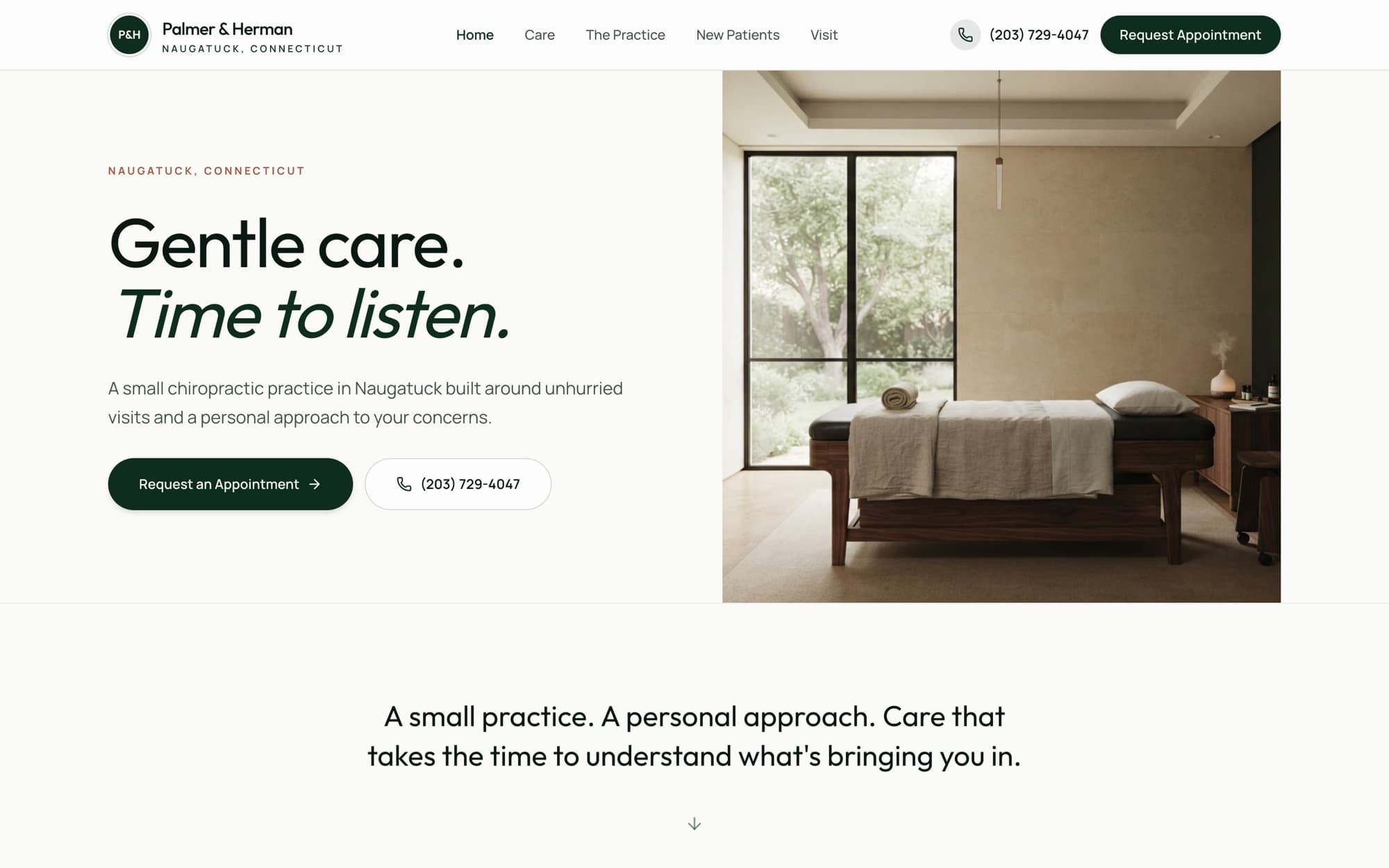
- Palmer & Herman Chiropractic, Naugatuck, CT (prospect demo)
- Engagement
- Reusable solution architecture
- My role
- Discovery, routing design, workflow logic, rollout boundaries
- Source
- blair-demo-palmer.vercel.app
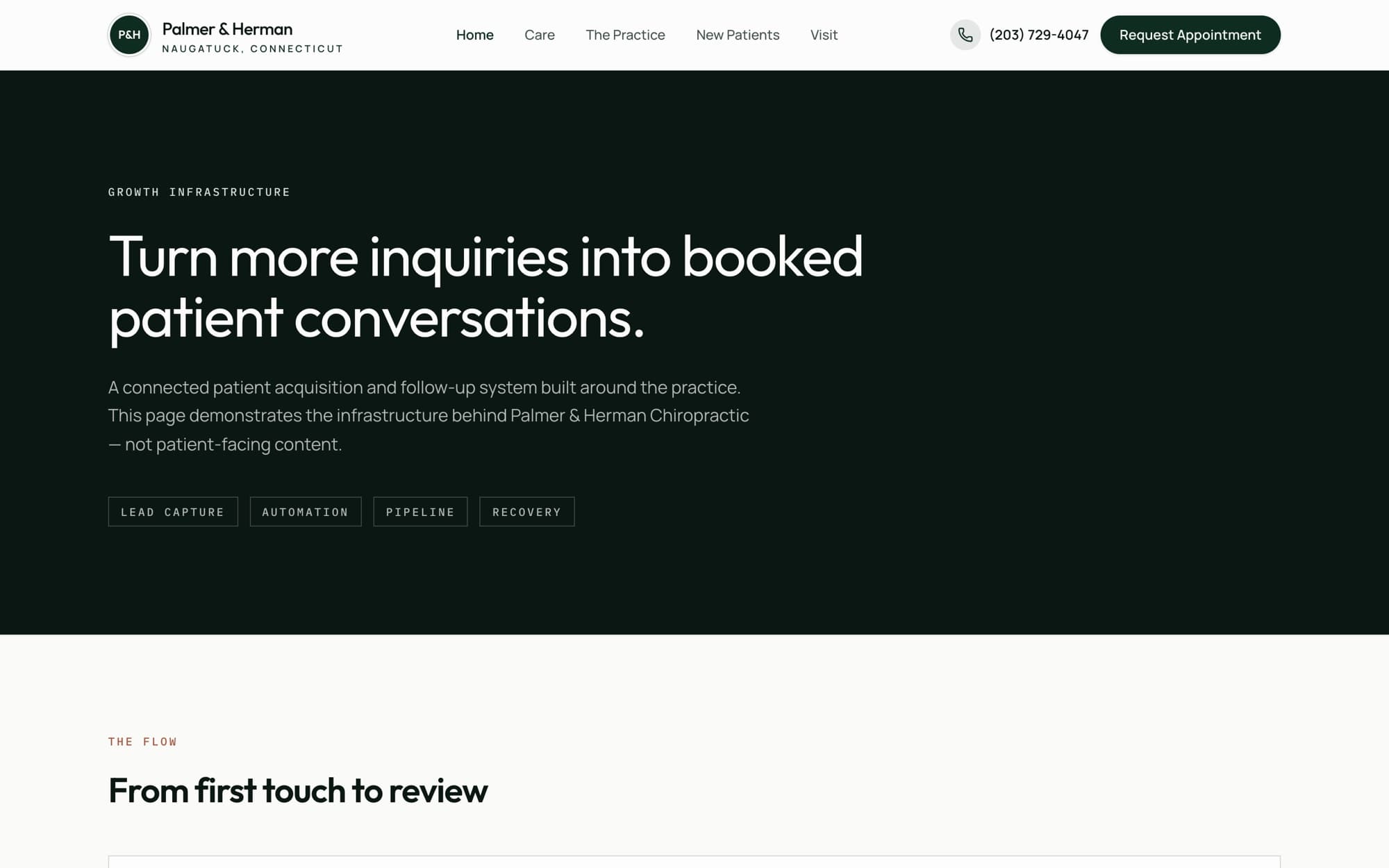
Status at time of writing
Stamped from the live build, not from the plan.
| Component | Status | Note |
|---|---|---|
| Patient website + revenue system | Live Published demo in the practice's brand. | Published demo in the practice's brand. |
| Live automation simulator | Demo data Runs demo contacts through the pipeline. No real patient records. | Runs demo contacts through the pipeline. No real patient records. |
| AI voice receptionist | Not activated Designed and scripted, deliberately not activated. | Designed and scripted, deliberately not activated. |
1Business problem
A second practice in the same category is where templates go wrong. Copy the first build and every client gets the same stages, the same messages, the same modules, whether they fit or not.
Palmer & Herman is two doctors, a different state and a different phone, and it needs its own launch plan.
2Discovery
- 2.1Separate what is structurally the same (how a lead becomes a patient) from what is specific (voice, stages, contact points, readiness).
- 2.2Decide what should go live first. The demo stages the rollout: capture, recovery, reminders and reviews now; AI voice later; reactivation only when staff choose to run it. A real engagement would confirm this in discovery.
3Requirements
| R-01 | Every website request lands in the CRM as a tagged lead with a pipeline opportunity. |
|---|---|
| R-02 | Missed calls get an automatic text-back after about a minute. |
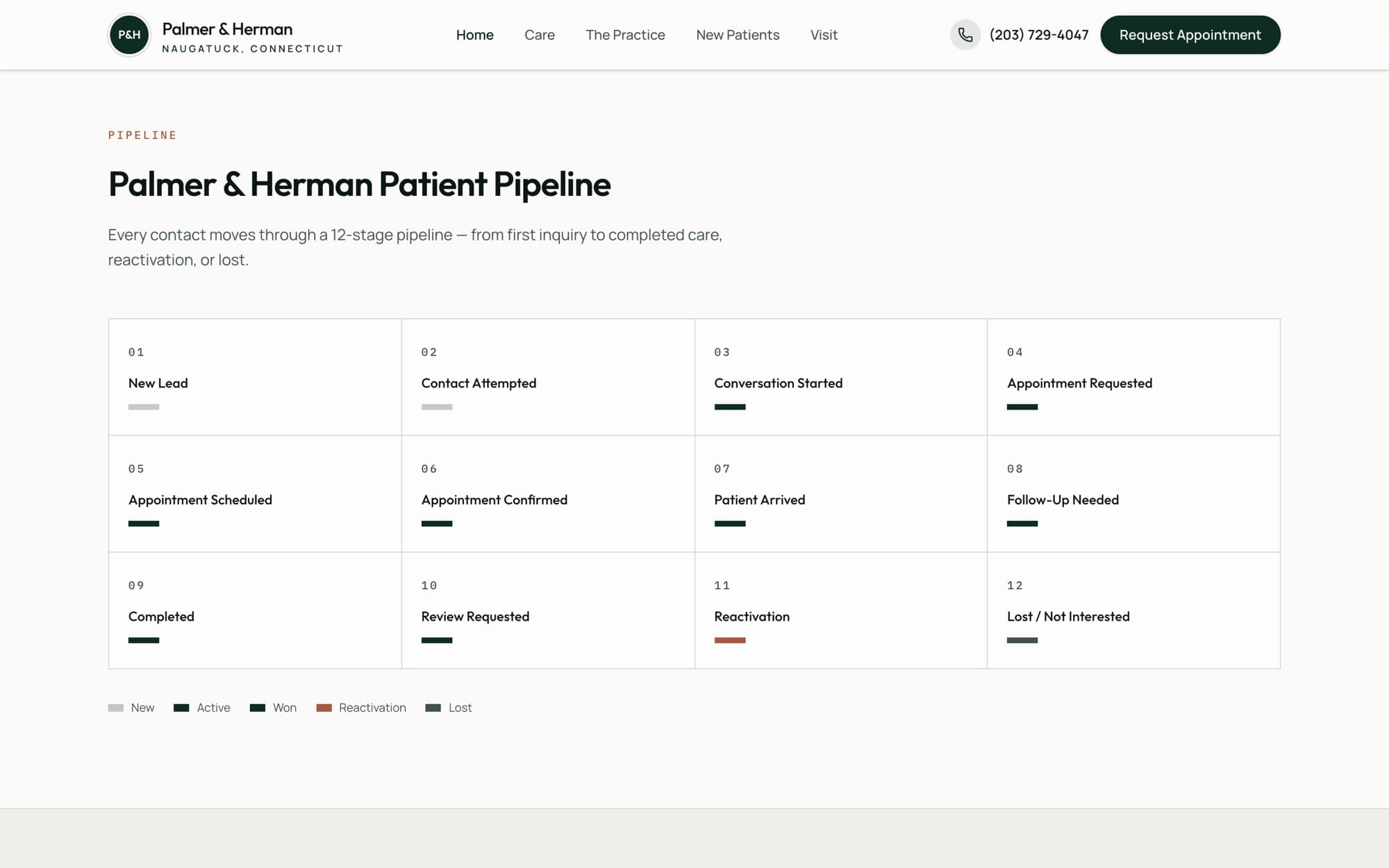
| R-03 | A 12-stage pipeline from New Lead to Completed, Reactivation or Lost. |
| R-04 | Follow-up that stops the moment a lead books, replies, opts out or is marked lost. |
| R-05 | Reminders 24 hours and 2 hours before each visit with time, address and phone. |
| R-06 | Ungated review requests after completed visits. No incentives, no gating. |
4Solution architecture
Eleven connected components share one pipeline. Routing is explicit, so every stage change has a reason.
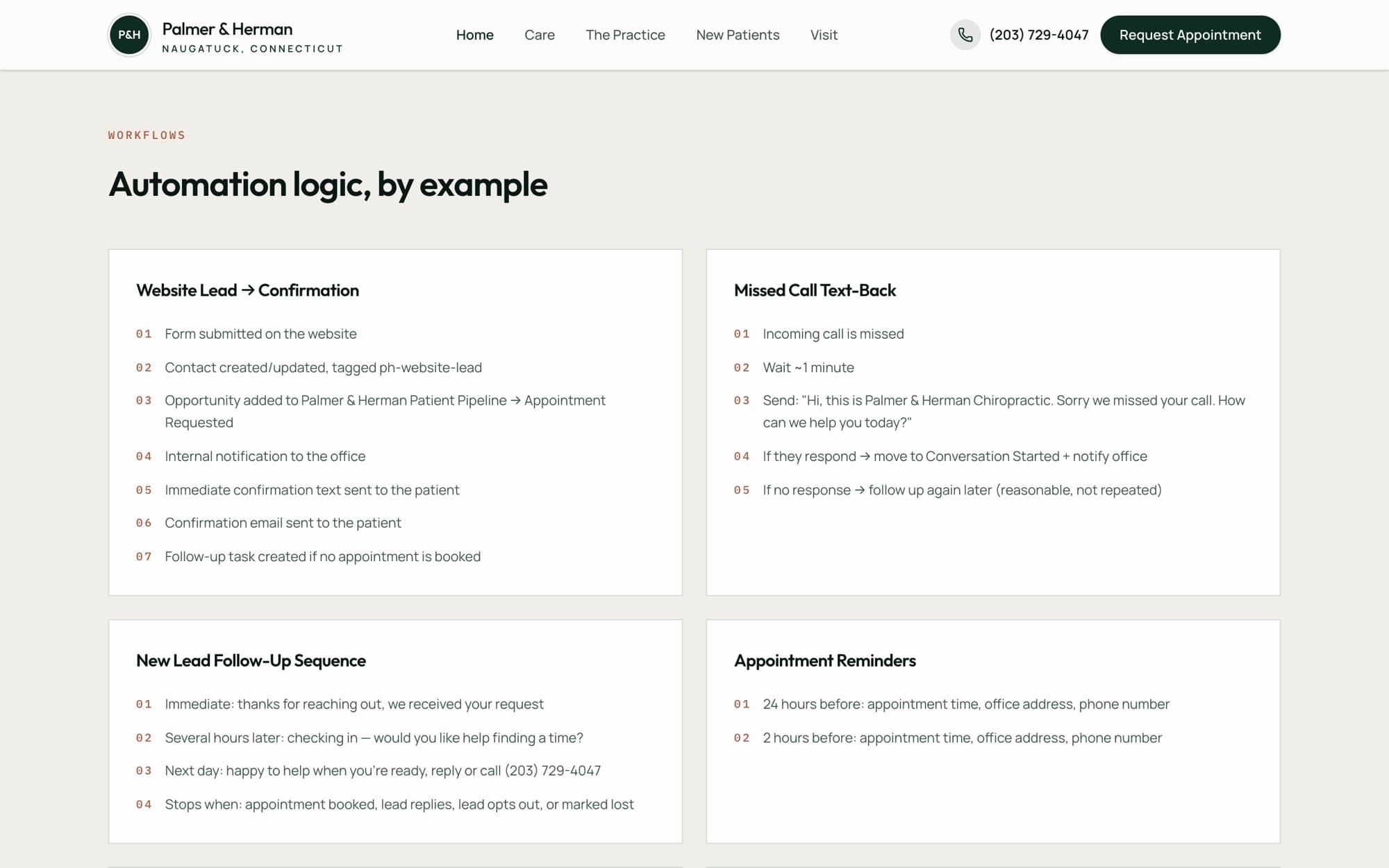
Website lead → confirmation
- 01Form submitted
- 02Contact tagged ph-website-lead
- 03Stage: Appointment Requested
- 04Office notified
- 05Confirmation text + email
- 06Task if not booked
Missed call → conversation
- 01Call missed
- 02Wait ~1 minute
- 03Text-back in the practice's voice
- 04Reply → Conversation Started
- 05Office notified
5Demo / POC
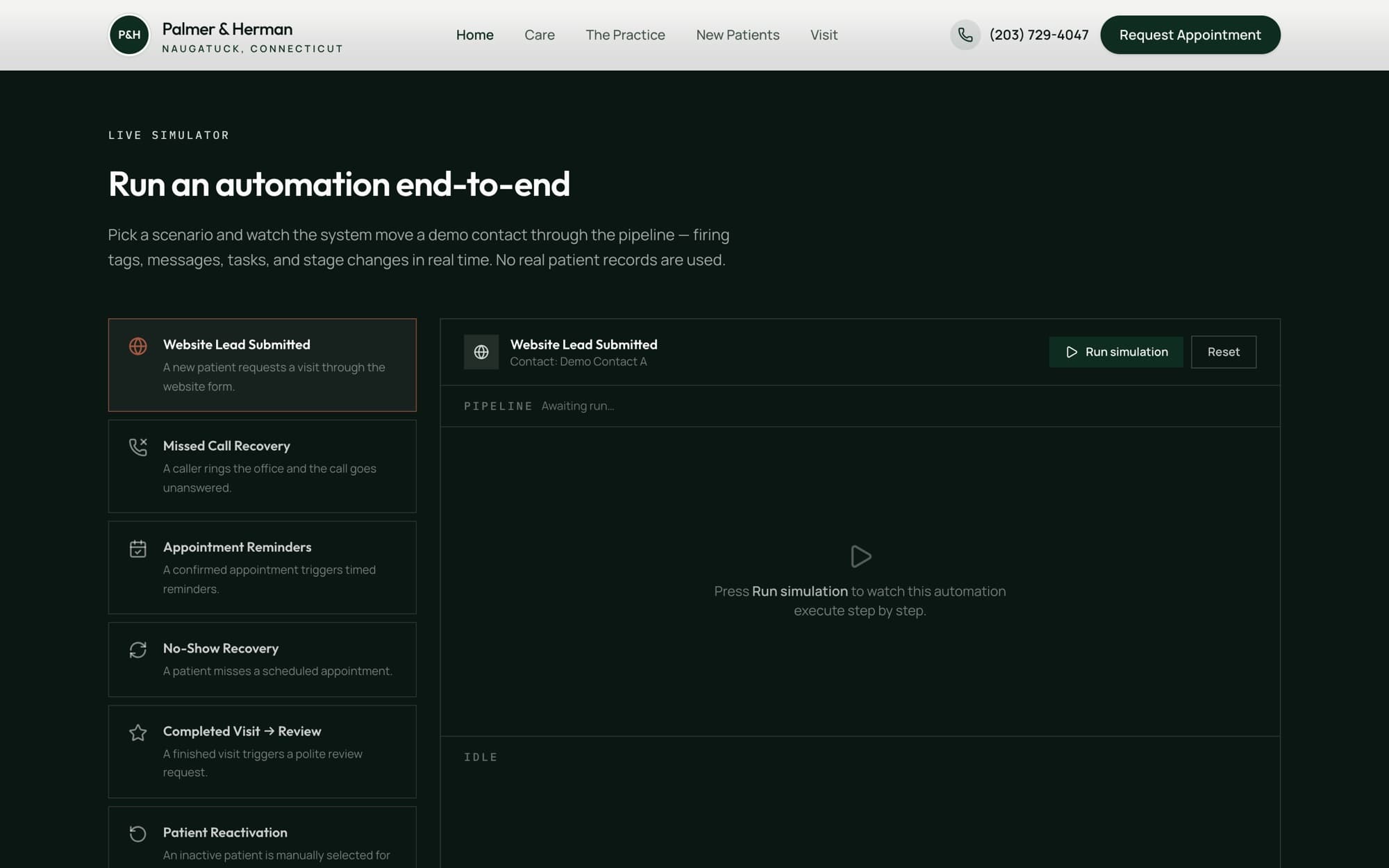
The owner picks a scenario and watches a demo contact move through tags, messages, tasks and stage changes.
6Technologies
- CRM pipeline + tags
- Web form capture
- Missed-call text-back
- SMS + email sequences
- Task automation
- Review requests
- Automation simulator
7Integration points
| From | To | Detail |
|---|---|---|
| Website form | CRMTag ph-website-lead + opportunity | Tag ph-website-lead + opportunity |
| Phone system | Missed-call workflowText-back after ~1 minute | Text-back after ~1 minute |
| Pipeline stage | Messages + tasksStage changes trigger the next step | Stage changes trigger the next step |
| Appointment status | No-show recovery / reviewNo Show, Cancelled, Completed | No Show, Cancelled, Completed |
8Tradeoffs
| Decision | Instead of | Why |
|---|---|---|
| Reuse at the logic layer | Instead of: Reuse at the brand layer | Capture → conversation → schedule → remind → review is universal. Stage names, tags, copy and modules are not. |
| Voice receptionist off at launch | Instead of: Shipping every module | A staged rollout keeps the first launch simple and protects the patient experience. |
| Manual reactivation | Instead of: Automatic win-back blasts | Staff choose who hears from the practice after a long gap. |
| Shared site skeleton | Instead of: A new layout per practice | Both practices sell unhurried care, so structure is reused on purpose; identity, doctors, services and contacts are theirs. |
9Implementation & handoff
- Implementation boundaries are written into the demo: what is active, what is manual, what is future.
- Voice receptionist guardrails are defined before activation: no diagnoses, no medical advice, medical questions escalate to staff.
- Every message template carries the practice's own name and number, ready for approval.
10What this demonstrates
- 1.Builds reusable solution architecture without flattening clients into one template.
- 2.Designs explicit routing and stop conditions, the part that decides whether automation feels respectful.
- 3.Scopes a rollout around the customer's readiness, not the product's feature list.